

We’ve all come to appreciate the convenience of quick and inexpensive transfers of cash, whether through apps like Venmo, Zelle and Cash App or traditional wire transfers and ACH transactions. The instantaneous flow of money has become a mainstay of the modern economy. But what if the U.S. government directly controlled the currency used for these transactions?
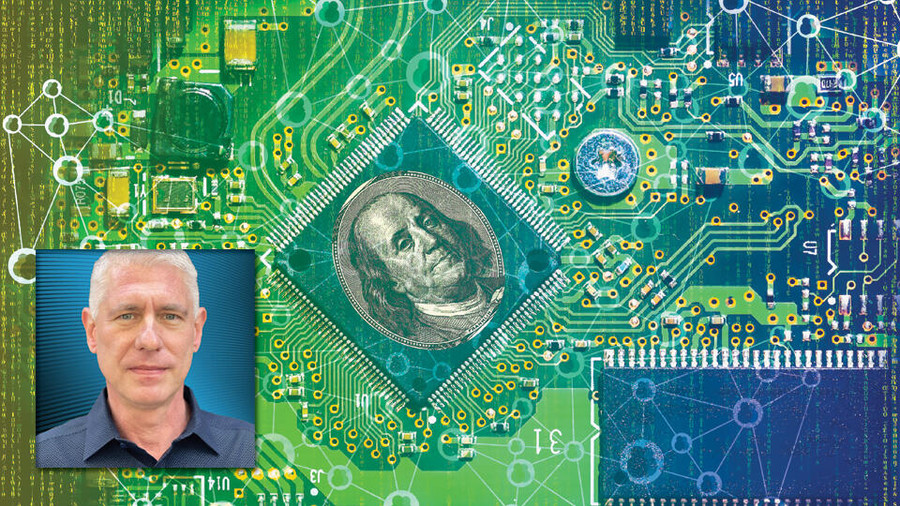
The concept of a U.S. Central Bank Digital Currency (CBDC) is currently being studied with intense interest by both the government and private sectors. In March 2022, lawmakers introduced the ECASH Act , which would allow the U.S. Treasury to create such a digital dollar and conduct a pilot program to study its viability. In the same month, President Biden signed an executive order calling for more research on development of a CBDC.
The ability to privately transact business in cash, cryptocurrency or electronic transfers without governmental approval is an essential freedom that should not be easily relinquished.
The Digital Dollar Project has launched a partnership between Accenture and the Digital Dollar Foundation to conduct research and spur public discussion on the potential advantages of converting to a digital dollar issued by the U.S. Central Bank. Things are moving fast in this direction, but there has been little discussion of the First Amendment implications of the government controlling all the currency we use to conduct business, fund political/charitable contributions and make everyday purchases.
A CBDC would differ from cryptocurrencies like Bitcoin and Ethereum, which are created and traded using blockchain distributed ledger technology (DLT). The CBDC would also not be the same as a “stablecoin” like Tether or USD Coin, backed by a fiat currency like the U.S. dollar. Instead, a CBDC would itself be fiat currency issued by the central banks and would not operate on the blockchain DLT. Likely, the CBDC would rely on a piece of secured hardware issued or authorized by the government for the purpose of receiving, storing and transferring digital dollars.
Theoretically, the CBDC could rely on privacy tools like “zero-knowledge proof technology” (ZKP), which proves that something is known without revealing the known information directly and keeps the details of the transaction hidden. For example, ZKP could validate that a person’s credit score meets a minimum threshold for a car loan without exposing the purchaser’s actual score. However, digital dollar transactions can function without the use of ZKP. Even if the technology is implemented, there is no guarantee that the central banks will keep transaction details hidden, leaving citizens to rely on their good faith.
Those in favor of converting to digital dollars argue that the U.S. will fall behind nations like China and Russia, along with over 90 other countries, which are already exploring issuance of their own CBDC. Potentially, the unique status of the U.S. dollar as the world’s reserve currency could be threatened. Proponents of the ECASH Act also claim that adoption of a uniform digital dollar system would help serve the unbanked or underbanked segments of society who do not have access to a private bank account or who live in areas without reliable internet access.
So, what could possibly go wrong if the government directly controls the issuance and transfer of all U.S. currency?
“Programmable money should terrify you,” says TV host and social media influencer Layah Heilpern. Such a system could result in “financial censorship” of citizens in the future, at the whim of the centralized authority behind it. Some have called the concept of a digital dollar “borderline dystopian.” To be sure, the adult industry has seen its share of financial censorship and discrimination by banks, payment processors and card associations that have closed accounts of adult performers, publishers and platform operators with little or no justification. In some cases, adult platforms have been required to make radical changes to their operating policies or comply with burdensome guidelines to continue accessing financial services.
But these actions have all been taken by private financial service providers who are free to make their own risk management decisions. A government-issued digital dollar would allow for potential direct control over the cash in your wallet. History shows that the government has a strong incentive to financially punish those who cross uncertain lines in the production and publication of adult content, even without a criminal conviction. State and federal law enforcement officials routinely pursue “civil asset forfeiture” of money and property without the need to prove any criminal violation. Horror stories abound detailing abuse of this procedure against innocent citizens who have lost their life savings without engaging in any criminal conduct.
Seeking redress in court against the wrongdoers is often a losing proposition due to the “qualified immunity” defense enjoyed by government actors in all but the most egregious cases. In 1993, the Supreme Court authorized the wholesale seizure of an entire adult business and $9 million in cash, including expressive materials that were not found obscene, as a penalty for selling a total of seven items that were deemed obscene in prior criminal prosecution. Nonetheless, all of these seizure and forfeiture actions require some minimal due process in the form of court authorization. If the government controls the digital dollars used for commerce, no court need be consulted.
The temptation to abuse direct power over digital cash will likely be too much for the government to resist. Naturally, the potential censorship concerns resulting from this power extend far beyond the adult entertainment industry and could be utilized against any person or business who refuses to toe the line and submit to the government orthodoxy of the day. Recall how government actors seized the authority to declare certain businesses “essential” and allowed them to operate during the initial months of COVID pandemic, while others were forced to shut down. With direct control over currency, the government could simply declare that money does not work at certain businesses, or for certain transactions. This government takeover of fiat currency is so radical, even the American Bankers Association opposes it.
The ability to privately transact business in cash, cryptocurrency or electronic transfers without governmental approval is an essential freedom that should not be easily relinquished. Once we hand over direct control of our money to the government, there is no return. As an industry that has experienced financial censorship firsthand, the adult entertainment community should raise its collective voice in opposition.
Lawrence Walters heads up Walters Law Group, which represents clients worldwide in all facets of the adult entertainment industry. For more information, visit Walters Law Group online on social media @walterslawgroup.



