



Digital Economy Bill Spoof Campaign Debuts

Digital Economy Bill Spoof Campaign Debuts

LONDON — The Open Rights Group has launched a spoof recruitment campaign to highlight the “absurd proposals” in the Digital Economy Bill, which was debated at its committee stage at the House of Lords today.

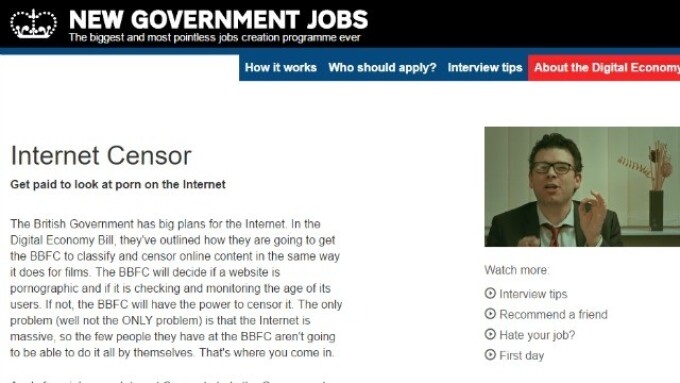
The spoof comes in the form of a website called “New Government Jobs — the Biggest and Most Pointless Jobs Creation Program Ever,” advertising “millions of positions available” for jobs as internet censor.

Passage of the U.K.'s Digital Economy Bill would mean the British Board of Film Classification (BBFC) would have to try and categorize all of the porn on the Internet.

“The British government has big plans for the Internet. In the Digital Economy Bill, they've outlined how they are going to get the BBFC to classify and censor online content in the same way it does for films,” the spoof site said. “The BBFC will decide if a website is pornographic and if it is checking and monitoring the age of its users. If not, the BBFC will have the power to censor it.

“The only problem (well not the ONLY problem) is that the internet is massive, so the few people they have at the BBFC aren't going to be able to do it all by themselves. That's where you come in.

“Apply for a job as an internet censor to help the government with their ambitious plan. Anyone with access to the internet can apply.”

The Open Rights Group, with its 3,000 active supporters, has all along dismissed the proposed law, emphasizing that the BBFC would be given the authority to order ISPs to block sites that don’t comply — even if the content on the site is perfectly legal.

“Social media sites, such as Twitter, may also be forced to block accounts belonging to non-compliant porn sites,” the group said. “The BBFC will have to classify massive amounts of adult content in order for this scheme to work. Age verification has privacy risks and could leave porn users open to Ashley Madison style hacks.

“No one thinks it will work. Tech-savvy teens will get around the proposals by using VPNs, Tor or sharing porn in other ways.”

The group also noted that the U.K. government is putting in place a framework where thousands of websites can be censored even though their content is legal.

“This can be used against porn sites for now but who knows how it will be used in the future. It means it will be much easier for the government to censor the website,” the group said.

With the site, the Open Rights Group is seeking signatures for a petition in an attempt to ax the bill.


Related:  

Copyright © 2026 Adnet Media. All Rights Reserved. XBIZ is a trademark of Adnet Media.
Reproduction in whole or in part in any form or medium without express written permission is prohibited.

More News

Texas Court Orders Adult Domain Locked for AV Violations

A district court in Texas has issued a writ requiring domain registry Verisign to “lock” an adult website’s domain over noncompliance with the state’s age verification law.

Adult Web Hosting Service 'QloudHost' Launches

QloudHost, a new web hosting service for adult websites, has launched.

Peter Hooke Launches New Paysite

Peter Hooke has launched an official website through PAYSITE.

Pineapple Support Names Ny Ny Lew as Brand Ambassador

Pineapple Support has named Ny Ny Lew as its newest brand ambassador.

Federal AV Proposal Passes House, Faces Senate Opposition

The U.S. House of Representatives on Monday passed the Kids Internet and Digital Safety (KIDS) Act, which includes provisions to make age verification by adult websites federal law, but the bill still faces tough going in the Senate.

Devin Drills Launches New Paysite

Creator Devin Drills has launched an official website through PAYSITE.

AV Bulletin: Midyear Roundup

Since the U.S. Supreme Court’s decision in Free Speech Coalition v. Paxton, more state age verification laws have been enacted around the United States, as well as proposed at the federal level and in other countries. Meanwhile, lawsuits resulting from AV laws have begun to play out in the courts. This roundup provides an update on the latest news and developments on the age verification front as it impacts the adult industry.

Judge Dismisses Last NCOSE-Backed Suit Over Kansas AV Law

A federal judge on Monday dismissed a lawsuit alleging that adult site SuperPorn violated Kansas’ age verification law, citing lack of jurisdiction after similarly dismissing two related cases earlier this year.

ASACP Updates 'Restricted to Adults' Labeling Resource Page

The Association of Sites Advocating Child Protection (ASACP) has updated its Restricted to Adults (RTA) labeling resource page.

Federal AV Proposal Scores Minor Win in House but Remains in Doubt

A newly announced bipartisan agreement in the U.S. House of Representatives Committee on Energy and Commerce may soon bring a proposed federal age verification law before the full House, but the measure continues to face an uphill battle.

Show More

