



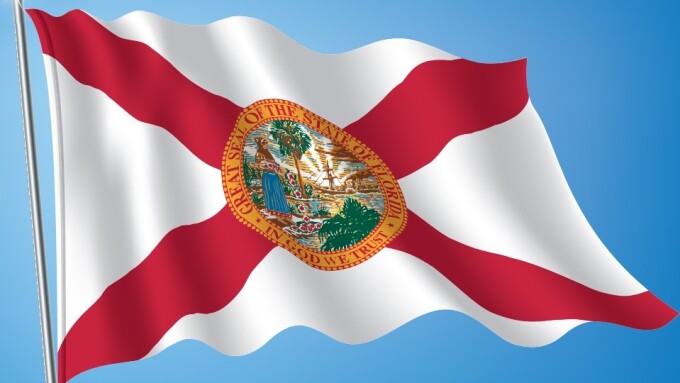
TALLAHASSEE, Fla. — The Florida House of Representatives today adopted a resolution claiming that the distribution of online adult content is a “public health risk.”
HR 157 doesn’t carry the force of law in the state, but it memorializes the branch of Legislature’s desire to create a “need for education, prevention, research and policy change to protect the citizens of this state.”
The resolution passed in the House today by a voice vote.
Similar measures have been filed or adopted in other states, including Utah, Kansas, Tennessee and Virginia.
But, so far, the Florida anti-porn resolution is the most significant because the state is the fourth-largest state in the U.S. with about 19 million residents.
The Free Speech Coalition didn’t immediately issue a statement over the news, but its executive director, Eric Paul Leue, pointed to a presentation the adult entertainment trade group earlier made over the issue of individual states calling out internet pornography as a “crisis” or “risk.”
Leue previously said that a “health policy based in outdated morality isn’t just bad for the adult industry, it’s bad for public health.”
Resolutions, like the one passed by the Florida House, are “not grounded and fact” and instead are “being used as a pretext to get around First Amendment restrictions on adult entertainment,” the executive director said in the presentation.
“No reputable, science-based public health organization has labeled pornography a public health crisis. Not the U.S. Department of Health and Human Services, the U.S. Centers for Disease Control and Prevention, the National Institutes of Health, the American Medical Association, the American Academy of Pediatrics, or any state health department,” Leue said.
The Florida House’s measure was filed by Rep. Ross Spano, who also is a candidate for state attorney general. To broaden support, Spano changed the original language of the bill from terming porn a “public health crisis” to a “public health risk.”
Last week, Spano told U.S. News and World Report that he realizes HR 157’s language is highly unpopular with many, particularly those involved in the industry.
“Anytime you brush up against what people perceive as a foundational constitutional right — the First Amendment, the right to free speech — you’re going to have understandable pushback,” Spano said. “The Supreme Court of the U.S. has made it clear that states have the ability to regulate obscene material. Obscenity has never been found to be a constitutional right.”
A similar Florida Senate resolution has yet to be heard in a committee.
Late Tuesday, industry attorney Lawrence Walters of Florida-based Walters Law Group told XBIZ that the "public health crisis" and "public health risk" resolutions are "a waste of time and taxpayer money."
"We have serious issues in Florida like school shootings, healthcare fraud and corruption," Walters said. "But adult entertainment is an easy political football that can be used when all else fails.
"I suspect this resolution will amount to nothing during the 2018 legislative session, but the political winds are shifting. As lawmakers continue to conflate adult media with human trafficking, addiction and prostitution, the industry should take notice."



