



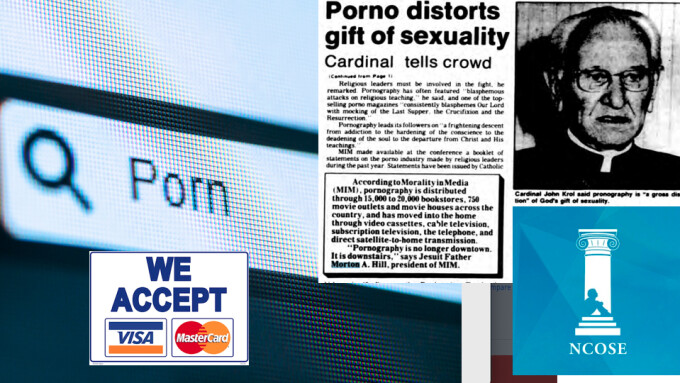
LOS ANGELES — Religiously inspired anti-porn lobby National Center on Sexual Exploitation (NCOSE) is currently stepping up its pressure on all major credit card companies to force them to stop processing payments for sexually-oriented industries, according to documents reviewed by XBIZ.
Yesterday, CEOs of several financial sector companies — which are part of the payment processing ecosystem for online commerce — received an email allegedly from a consortium of international organizations, including NCOSE, urging them “to stop processing payments for the pornography industry.”
The email, with the subject line “International Concern Over Your Company’s Involvement in Sexual Exploitation” spreads the usual, widely debunked propaganda points beloved of War On Porn activists (e.g., "all porn is human trafficking," "no such thing as consensual porn," "porn is a public health crisis," "porn addiction is a medical condition").
NCOSE was founded in the mid-1960s as a religious group and has rebranded over the years (as a recent XBIZ article investigated) in order to deceive mainstream journalists into quoting them as unbiased "experts." The group was known until not long ago as Morality in Media, before their latest — and most deceptive — rebranding.
Although the email claims to come from a group of organizations from “Australia, Belgium, Bolivia, Canada, Denmark, England, India, Ireland, Liberia, Scotland, Sweden, Uganda and the United States of America,” the material appears to have originated, like much of War On Porn propaganda, within the task groups of the well-funded NCOSE.
The email even concludes by asking the CEOs “if you would like to discuss these matters further” to “reach out to public@ncose.com.”
The request for credit card companies to stop processing payments for adult content is justified by NCOSE by claiming consensual, legal porn is identical to “child sexual abuse, sex trafficking videos, rape, and more” and “content eroticizing sexual violence, incest and racism.”
NCOSE claims that processing payments for erotic content is tantamount to “aiding human rights Violations [sic].”
The latest attack on the adult entertainment industry specifically mentions “live webcam videos,” Pornhub (a familiar, visible target), and “the entire pornography industry,” which NCOSE wants to censor out of existence because of the alleged impossibility “of producing a real metric to measure consent in any pornography on its site, aside from complaints from victims of non-consensually shared porn.”
For NCOSE, all adult entertainment content and all sexual expression is non-consensual, regardless of the statements of consent in productions.
The lobby even considers Sports Illustrated as “hardcore pornography” and has lobbied — with some success, according to their press releases — to have stores remove it from public view.
Other justifications in the email, which includes footnotes, lead to mainstream coverage of the activism of religious organizations like Exodus Cry, a charismatic Christian ministry with Midwestern origins (originally an offshoot of the extremely controversial International House of Prayer), and Mormon-based organization Fight the New Drug.
NCOSE/Morality in Media is hoping that credit card companies would fall for their multiple deceptions (the bogus group of “international organizations,” the footnotes that lead to faith-based propaganda they’ve planted in the mainstream media) and make it even more difficult for law-abiding sex workers and adult entertainment businesses to get paid without stigma and harassment.
Last week, NCOSE attempted to shame the CEO of McDonald's into spreading anti-sex work propaganda among its workers, who are trying to feed themselves during the current public health crisis, suggesting that starvation is more honorable than making sexual content.
NCOSE is also behind the copycat legislation introduced by evangelical lawmakers in almost 20 U.S. legislatures attempting to declare "pornography is a public health crisis." These efforts had as a goal the derivation of funds and initiatives from actual health crisis prevention (like COVID-19).
Image: Anti-porn propaganda (1985) by NCOSE, under their previous name Morality in Media. Back in the 1980s, the organization featured clergymen prominently as their spokespersons.



