



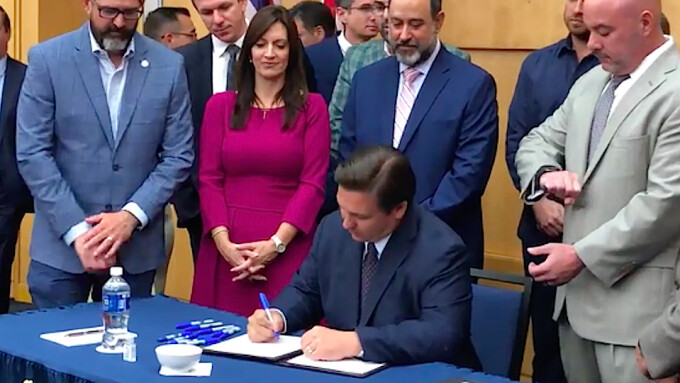
TALLAHASSEE, Fla. — Florida Governor Ron DeSantis held a ceremony today to sign a new state bill into law that would criminalize some of the moderation practices of social media platforms in the name of “free speech,” although language concerning sexual expression carves out an exception that allows the restriction of anything that might be considered “obscene” by the platforms, as defined by Florida statutes.
The bill, SB7072, was described by DeSantis’ Lieutenant Governor Jeanette Nunez during today’s ceremony at Florida International University in Miami as a response to what she called “an effort to silence, intimidate and wipe out dissenting voices by the leftist media and big corporations.”
“Many of our constituents know the dangers of being silenced or have been silenced themselves under communist rule,” Nunez stated. “Thankfully in Florida we have a Governor that fights against big tech oligarchs that contrive, manipulate and censor if you voice views that run contrary to their radical leftist narrative.”
Florida House Speaker Chris Sprowls claimed SB7072 “protects the free speech of Floridians and demands transparency. No more secret algorithms, inconsistent standards, shadow banning and de-platforming. In Florida, sunshine is the best disinfectant — and it’s time we bring these big tech monopolies out of the dark.”
But although the Republican governor and lawmakers claimed their bill protects “free speech” and penalizes what they call “censorship of political statements,” specific language inserted into the bill concerning “obscenity” still encourages platforms to ban sexual expression.
Florida's Outdated 'Obscenity' Definitions
Section 501.2041 (Unlawful acts and practices by social media), 2 (j), states that “a social media platform may not take any action to censor, de-platform, or shadow ban a journalistic enterprise based on the content of its publication or broadcast. Post537 prioritization of certain journalistic enterprise content based on payments to the social media platform by such journalistic enterprise is not a violation of this paragraph. This paragraph does not apply if the content or material is obscene as defined in s. 847.001.”
A further passage states that “notwithstanding any other provisions of this section, a social media platform is not required to notify a user if the censored content or material is obscene as defined in s. 847.001," a reference to the definitions section of Florida’s infamous “Criminal Obscenity” statute, which states that “Obscene” means “the status of material which: (a) The average person, applying contemporary community standards, would find, taken as a whole, appeals to the prurient interest; (b) Depicts or describes, in a patently offensive way, sexual conduct as specifically defined herein; and Taken as a whole, lacks serious literary, artistic, political, or scientific value.”
The definition is followed by the highly specific clarification that, “a mother’s breastfeeding of her baby is not under any circumstance ‘obscene.’”
That section of the Florida’s outdated “Criminal Obscenity” statute also defines “deviate sexual intercourse” as “sexual conduct between persons not married to each other consisting of contact between the penis and the anus, the mouth and the penis, or the mouth and the vulva.”
It also defines that “sexually oriented material” as “any book, article, magazine, publication or written matter of any kind or any drawing, etching, painting, photograph, motion picture film or sound recording that depicts sexual activity, actual or simulated, involving human beings or human beings and animals, that exhibits uncovered human genitals or the pubic region in a lewd or lascivious manner, or that exhibits human male genitals in a discernibly turgid state, even if completely and opaquely covered.”
'Little More Than Grandstanding'
Free speech experts pointed out to XBIZ that “Section 230 already allows online platforms to censor obscene material, so this bill does not change that existing right. Florida’s obscenity definition tracks the Miller Test [regarding obscenity], so there’s no real issue there.”
Adult industry Larry Walters, from the Walters Law Group, told XBIZ that the statute "appears to be little more than grandstanding, since regulation of online platforms is a matter of federal, not state law."
“Most, if not all, of these restrictions,” Walters continued, “are preempted by federal law; i.e., Section 230. Numerous cases have held that state-level attempts to regulate the internet violate the dormant Commerce Clause and are therefore unconstitutional.”
A Conundrum for the Courts
But even if SB7072 is not a departure from what Section 230 already allows platforms to do concerning material that may be considered by some “obscene” or “purient,” what makes the explicit carve-out of sexual expression peculiar is that DeSantis and the Florida Republicans continue touting this law as one that protects what they call “free speech.”
A conundrum for the courts, besides the myriad constitutional issues this law will certainly face, would be if someone were to claim that their sexual expression constitutes political expression, or if sex workers or pornographers filed paperwork as Florida political candidates.
Either of those acts would cause a short-circuit between the law’s supposed anti-censorship intent and its blatant embrace of censorship when it comes to sexual expression.
Main Image: Florida Governor Ron DeSantis (R) signing the "Free Speech" law today