

Elon Musk Cracks Down on Twitter 'Impersonation' Accounts

Elon Musk Cracks Down on Twitter 'Impersonation' Accounts

LOS ANGELES — New Twitter owner Elon Musk has vowed to crack down on impersonation accounts, a long-standing concern for adult performers on the platform who have been shadow-banned or suspended even while fake accounts with thousands of followers thrive.

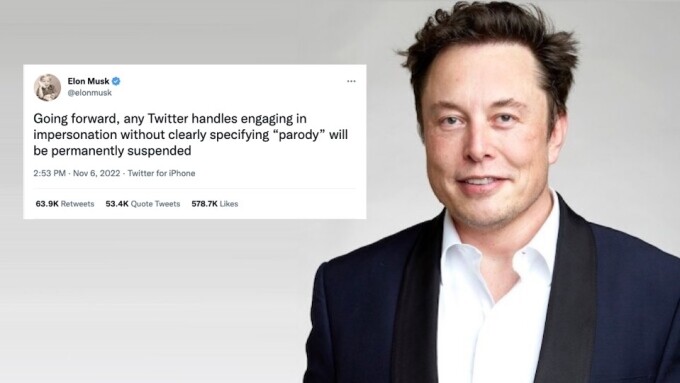
Musk announced his decision via Twitter over the weekend, after several verified “blue check” accounts changed their user name to “Elon Musk” to spoof the billionaire.

“Going forward,” Musk decreed, “any Twitter handles engaging in impersonation without clearly specifying ‘parody’ will be permanently suspended.”

“Now that we are rolling out widespread verification, there will be no warning,” Musk added. Previously, impersonators received warnings before being suspended.

Today, Musk tweeted, “Twitter rules will evolve over time, but they’re currently the following,” linking out to the current policies, including a section on “authenticity.”

That policy reads, “You may not impersonate individuals, groups, or organizations to mislead, confuse, or deceive others, nor use a fake identity in a manner that disrupts the experience of others on Twitter.”

Adult performers and other sex workers have repeatedly complained to little avail about Twitter’s routine practice of shadow-banning, or "ghost-banning," their accounts while leaving impostors unmolested.

Immediately after purchasing Twitter, Musk told a follower he would be “digging into” the practice of shadow-banning, a term and concept that large platforms like Twitter, Facebook and Instagram have been extremely reluctant to discuss openly.


Copyright © 2026 Adnet Media. All Rights Reserved. XBIZ is a trademark of Adnet Media.
Reproduction in whole or in part in any form or medium without express written permission is prohibited.

More News

Flirt4Free Wins Trademark Infringement Case Against Copycat Website

The World Intellectual Property Organization (WIPO) has ruled in favor of Flirt4Free in a case against a copycat website using an infringing domain.

Irish PM Affirms Plan for UK-Style Ban on 'Extreme' Content

Ireland’s prime minister on Wednesday confirmed that his government is moving ahead with plans to introduce legislation criminalizing possession and distribution of “extreme” pornography, which he hopes to see passed by early 2027.

UK Parliamentary Group Calls for Outlawing Cam Platforms

The U.K. Parliament’s All-Party Parliamentary Group (APPG) on Commercial Sexual Exploitation has published a report in which it calls for banning adult livestreaming platforms.

Ofcom Escalates Sun Social, Superb Convert Investigations

U.K. media regulator Ofcom has ramped up its ongoing Online Safety Act (OSA) compliance investigations into PlayVids/PeekVids operator Sun Social Media and PimpBunny operator Superb Convert.

Centrobill Rolls Out Apple Pay, Google Pay Options

Centrobill has added Apple Pay and Google Pay options for merchants.

Judge Preliminarily Approves Pornhub Class Action Settlement

A U.S. District Court judge on Monday granted preliminary approval to a settlement between Aylo and the plaintiffs in two class-action lawsuits over allegations that former Pornhub parent company MindGeek knowingly allowed and profited from CSAM on its sites.

Roald Riepen Steps Down as CEO of IMC

Roald Riepen, CEO of International Media Company (IMC), is stepping down.

Ofcom Sets Timeline for Enforcing 'Extreme' Content Rules

Before U.K. media regulator Ofcom begins enforcing new laws criminalizing certain “extreme” adult content online, it will first hold a consultation in early 2027, and then provide updated guidance for sites and platforms.

FSC Publishes Guidance on New UK Pornography Laws

The Free Speech Coalition (FSC) has published information for its members on the United Kingdom's recently passed pornography laws, which take effect next week.

Brazil Issues Guide to Digital Safety Compliance

Brazil’s National Data Protection Agency (ANPD) published on Wednesday a new guide outlining online providers’ child-protection responsibilities under the Digital Statute for Children and Adolescents (Digital ECA), which requires adult websites to age-verify users located in Brazil.

Show More

